


Updated August 2026 to reflect HMRC's new volunteer mileage rate
1. Introduction: Volunteers Cannot Afford To Be Left Out Of Pocket
Q: Is paying volunteer expenses linked to retention?
A: Yes, significantly. According to NCVO's Time Well Spent 2023 report, the proportion of people who cited financial worry as a reason not to volunteer nearly tripled between 2019 and 2023, rising from 5% to 14%. For a growing number of people, it is the deciding factor in whether they keep showing up. The cost of living pressures that have intensified recently due to political conflicts have exacerbated this issue.
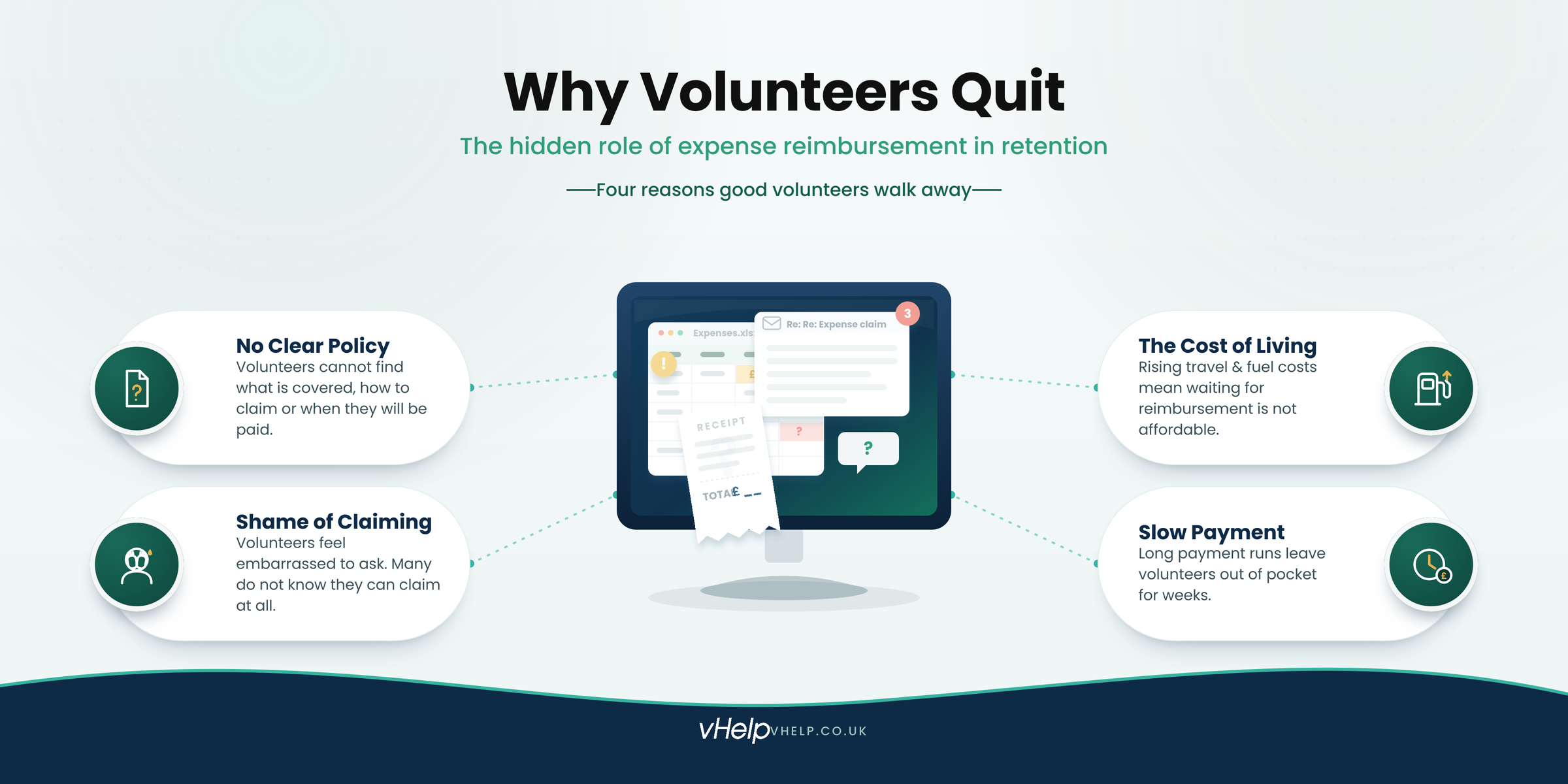
Volunteers do not quit because they have stopped caring. They quit because the bus fare was £4.80 and they have been waiting three weeks to get it back. They quit because nobody told them they can claim expenses. They quit because they were too embarrassed to ask, or because the claim form was a spreadsheet that required four signatures and ten working days. They quit, and they do not explain why. They just stop coming.
UK charities lose volunteers every year to a problem that is almost entirely preventable. It is not a recruitment problem. It is not a motivation problem. It is an operational one.
This paper brings together evidence from conversations with volunteers, organisations and the sector's own research to make the case plainly: the way a charity pays volunteer expenses is a retention strategy, and must be treated as one.
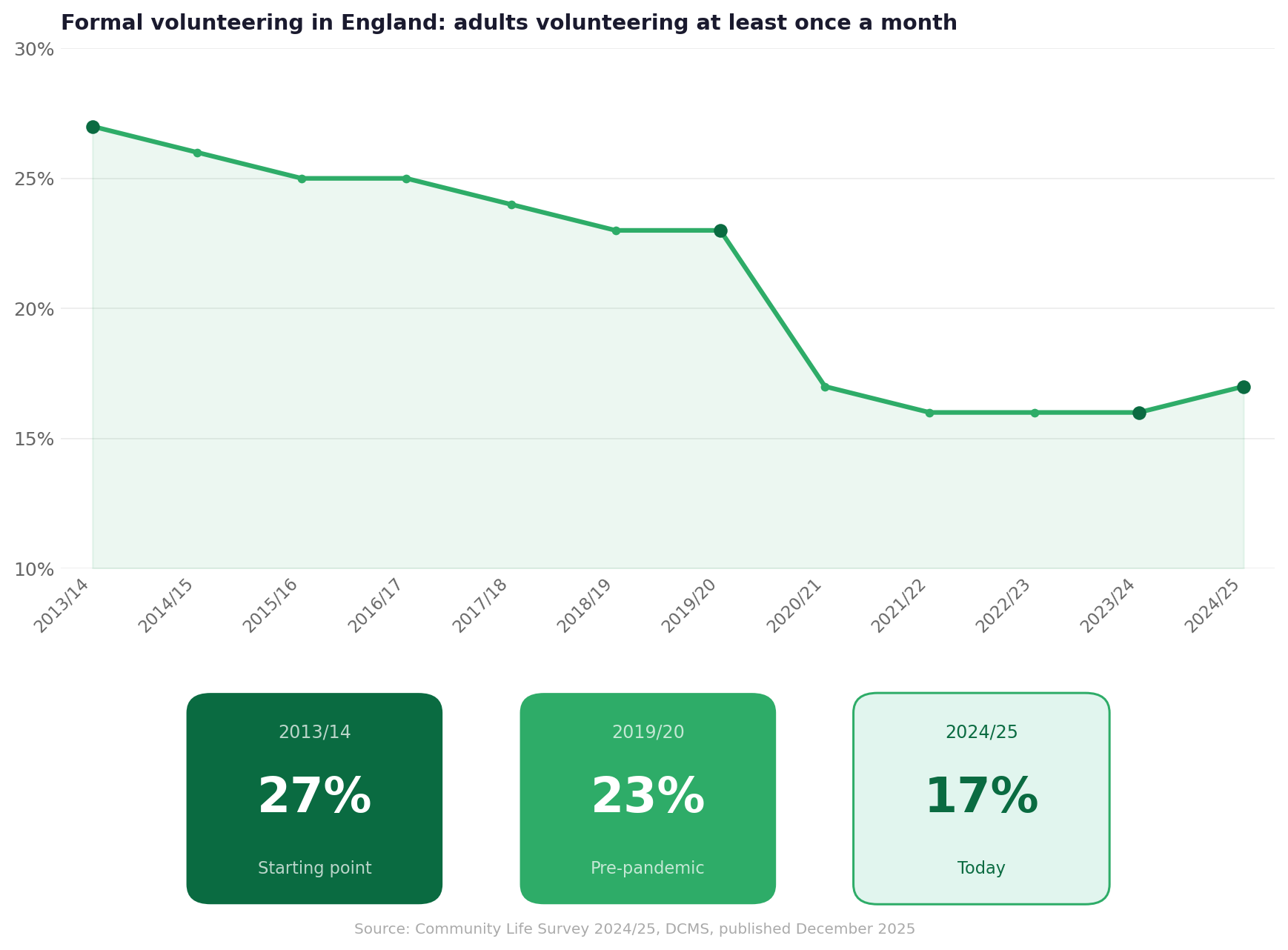
Formal volunteering in England has fallen from 27% of adults in 2013/14 to just 17% today.
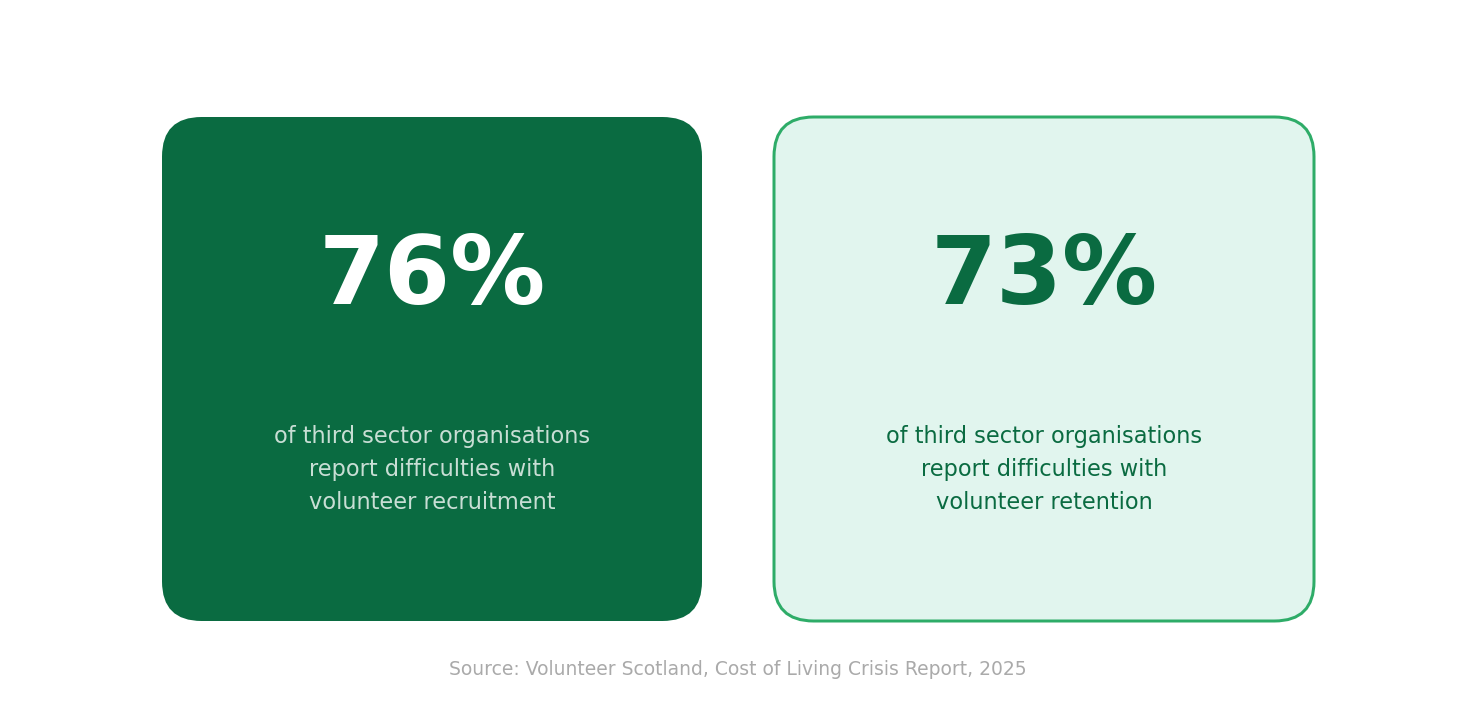
That means nearly half of volunteers are not confident their expenses will be covered. Most who do claim are waiting weeks to see the money. And a growing proportion of potential volunteers are not coming forward at all because they cannot afford to take the risk of being out of pocket.
The organisations that understand this are starting to change. They are publishing their expenses policies. They are paying within 24 hours. They are using the process itself as a way to demonstrate to volunteers that they are valued.
On the other hand, the organisations that bury their expenses policy in an induction pack nobody reads, that take four weeks to pay back a bus fare, that assume their volunteers do not need the money, are watching their volunteer base quietly narrow, becoming older, whiter and more affluent, and wondering why recruitment efforts are not working.
This is not just an organisational challenge. NCVO explicitly calls on government to fund organisations properly to ensure they can pay expenses, noting that charities are struggling with the rising cost of delivery and falling income. The case for paying expenses is no longer just good practice. It is an inclusion and retention imperative.
This paper is for the volunteer managers, trustees and operations leads who want to fix it.
2. Are Your Volunteers Embarrassed To Ask About Expenses?
Q: Why do volunteers choose not to claim expenses even when they are entitled to them?
A: Many volunteers do not claim expenses because they feel embarrassed, fear judgment from peers, or simply do not know they can. NCVO's Time Well Spent 2023 report found that 16% of volunteers do not even know whether their organisation would reimburse expenses at all. This is not a funding problem. It is a communications failure, and it costs charities volunteers they cannot afford to lose.
There is a quiet culture in many UK charities that treats not claiming as a virtue. The volunteer who waves away the claim form is quietly admired. The one who submits it occasionally feels they have done something slightly ungracious. Nobody says this out loud. They do not need to.
There are two distinct stigmas at play here, and it is worth naming both of them.
The first is organisational. Many charities will say, often with pride, that their volunteers do not claim expenses. What they do not realise is the pressure that creates for the volunteers who do need to claim. By celebrating those who do not ask, they make it harder for those who must.
This is particularly common in sports and leisure charities where the volunteer base skews affluent. One CEO of an equestrian charity approached vHelp wanting to make expenses easier to claim, precisely because she wanted to diversify her volunteer pool. Her board of trustees rejected the idea outright, saying their volunteers do not claim and do not ask. She was perceptive enough to see what the board could not: that a volunteer base made up entirely of older, financially comfortable people is not a diverse one. It is simply the only kind of person who could afford to stay.
The second stigma associated with volunteer expenses, is peer-to-peer, and it is arguably more damaging. Some volunteers, particularly those who are financially comfortable, can make others feel guilty for claiming. This becomes most visible when the process is public. A volunteer filling in a paper form at the end of a shift, in front of colleagues, is exposed.
One volunteer told us she was publicly shamed by a fellow volunteer who said, with a smile, 'do you really need to claim?' It rarely comes from a malicious place. It usually comes from love for the charity and the cause they serve. But the effect is the same: the volunteer who needed that £6 bus fare back quietly decides it is not worth the discomfort.
The consequences are real. Volunteers who feel embarrassed about claiming are effectively subsidising the organisations they give their time to. And the volunteers who can least afford to do that are the ones most likely to stop coming.
3. Can Volunteers Find Your Volunteer Expense Policy?
Q: What should a charity's volunteer expenses policy cover and where should it be published?
A: A volunteer expenses policy should set out what expenses are covered, how volunteers can claim, what tools or systems are used to submit a claim, and how long reimbursement will take. It should be published on the charity's website, included in induction sessions, and referenced in volunteer briefing packs. See below for more detail on what to include.
If a volunteer has to ask whether expenses are paid, you have already created a barrier. The whole point of a visible, accessible policy is that the question never needs to be asked. The volunteer can find it, read it, understand it, and claim with confidence. That is what removes the embarrassment described in the previous section.
Expenses should be covered as a matter of course when a volunteer joins, in the same way health and safety, safeguarding and data protection are covered. Your expense policy should be easily accessible on your website, in induction sessions and briefing packs. It is part of how you run a responsible volunteering programme.
Here is what a good expenses policy should cover.
3.1. What volunteer expenses do you cover?
Be specific. List the expense categories you cover: travel to and from the volunteering location, mileage for those driving their own vehicle at the HMRC approved rate, parking, public transport, meals where volunteering extends across a mealtime, caring costs such as childcare or care for a dependent, and any equipment or materials the role requires. If there are upper limits on any category, state them clearly. Volunteers should not have to guess what is covered and what is not.
3.2. How can volunteers claim expenses?
Spell out every step. State clearly what platform or system you use, name it, link to it, and explain how to access it. Do volunteers complete a form online, on paper, or through an app? Where do they send it? Who approves it? What evidence do they need to provide, receipts, tickets, mileage logs? If you are still using paper or emailed forms, be honest about that too. The simpler and more explicit this is, the more likely volunteers are to follow it through. A process that requires interpretation will be abandoned.
3.3 How long does it take to reimburse the expense?
NCVO's guidance states that it is good practice to pay expenses within one month. One month should be treated as the absolute maximum, not the target. State your timeline clearly in the policy and then meet it.
Publishing this policy on your website does something else too. It signals to potential volunteers, before they have even applied, that your organisation takes this seriously. For someone on a low income weighing up whether they can afford to volunteer, that signal matters enormously. It may be the reason they get in touch rather than scroll past.
If you would like a template volunteer expenses policy you can adapt for your organisation, get in touch at hello@vhelp.co.uk
4. The Cost Of Living Reality: Volunteering Costs
Q: How does the cost of living affect volunteer retention in UK charities?
A: The cost of living crisis has made volunteering financially unaffordable for a growing number of people. The Community Life Survey 2024/25 found that in the most deprived areas of England, 17% of non-volunteers cite financial costs as a barrier to volunteering, compared with 10% in the least deprived areas. Charities lose volunteers if they do not reimburse expenses promptly.
Volunteering has never been without cost. Travel, parking, a meal grabbed between shifts, childcare arranged to cover an afternoon session. For many volunteers these costs have always existed in the background, absorbed quietly and without complaint.
That quiet acceptance is no longer something charities can rely on.
The Joseph Rowntree Foundation cost of living tracker, carried out in late 2025, found that more than half of low-income households had gone without heating to reduce energy bills, and over 5 million households had cut back on or skipped meals because they could not afford food. These are not edge cases. These are people in every community, in every town, who are also giving their time to charities, food banks, hospices, sports clubs and community organisations across the UK.
The situation worsened sharply in early 2026 following the military strikes on Iran. UK inflation rose to 3.3% in March, driven by motor fuel costs that jumped 8.7% in that single month alone, the sharpest monthly rise in fuel prices since the outbreak of war in Ukraine in 2022. For volunteers who drive to their roles, that is not an abstract statistic. It is a £10 to £15 jump in the cost of a full tank, in one month, with no warning. The House of Commons Library notes that household gas bills are expected to rise further later in 2026 as a direct result of energy market disruption. The cost of showing up to volunteer has rarely been higher.
For volunteers already absorbing the cost of getting to their roles, this is unpredictable pressure. The calculation of whether volunteering is affordable has become harder.
4.1 The Real Cost of Getting There
Travel is the single biggest out-of-pocket cost for most volunteers. For someone driving just 6 miles each way to a twice-weekly shift, that is around 1,200 miles a year. Following HMRC's rate increase in May 2026, at the new approved rate of 55p per mile that is around £55 a month, and over £660 a year. If the organisation takes four weeks to reimburse, that volunteer is carrying the cost of multiple trips before seeing a penny back. For volunteers on tight budgets, that wait is itself a reason to stop.
Public transport costs tell the same story. For volunteers travelling by bus or train, particularly in rural areas where services are infrequent and fares are high, a return journey can easily cost £10 or more per session. Twice a week, that is around £87 a month, over £1,000 a year. Unlike fuel, this cost cannot be spread across other journeys or absorbed into a household car budget. It is a direct, recurring expense. When reimbursement takes four weeks, a volunteer may be out of pocket by two or three months of travel costs before they see anything back. For someone on a fixed or low income, it is a stretch.
4.2 Young volunteers are most exposed
NCVO's Time Well Spent 2023 report found that 20% of 18 to 24 year olds cited worry about being left out of pocket as a reason not to volunteer, compared with 14% across all age groups. Young volunteers are also the least likely to have financial reserves to draw on while waiting for reimbursement. They are the demographic most likely to be in insecure or part-time work, most likely to be renting, and most likely to feel the gap between spending now and being paid back later
This matters because young volunteers are also the group charities most frequently say they want more of. The gap between wanting to attract younger volunteers and operating a payment process that actively deters them is one that charities can only close with faster reimbursement.
4.3 The interest-free loan nobody agreed to
When a volunteer spends money to show up and waits four weeks to see it back, they are effectively subsidising your organisation. For a volunteer on a comfortable income, that is an inconvenience. For a volunteer on Universal Credit, a zero-hours contract, or a state pension, it may be genuinely unaffordable.
NCVO specifically advises that for volunteers on low incomes, advance payment of expenses should be considered, as they may not be able to front costs and wait to be reimbursed. If the default in the sector remains pay upfront and claim later, then the speed of that volunteer expense reimbursement is essential.
The cost of living has changed the calculation. What was once a minor inconvenience for most volunteers is now a genuine barrier for many. Charities that do not adjust how they handle expenses are losing volunteers to financial reality.
5. Diversity And Inclusion: Who Quietly Walks Away
Q: Does paying volunteer expenses improve diversity and inclusion in charities?
A: Yes, directly. NCVO's research shows that covering expenses removes financial barriers and broadens participation, strengthening connections with diverse communities and helping organisations attract volunteers from all backgrounds. Volunteers who cannot afford to front costs and wait weeks for reimbursement are disproportionately those from lower income households, younger age groups and the global majority. When charities make expenses easy to claim and fast to pay, they remove one of the most significant and least discussed barriers to a diverse volunteer base.
Charities talk a great deal about diversity. They update recruitment materials, review imagery, write EDI strategies and attend sector conferences on inclusion. And then they send volunteers a paper expense claim form and make them wait a month to be paid back.
NCVO's research found that volunteers from the global majority feel less satisfied, more excluded, and are less likely to continue volunteering compared to volunteers overall. Financial friction is one of the most direct causes of this, and one of the most fixable. The volunteers most likely to be deterred by slow or complicated expense processes are precisely those charities say they most want to attract.
5.1 The volunteers who cannot afford to wait
Not all volunteers experience financial pressure equally. A retired professional with savings can absorb a four-week wait for a bus fare. A single parent on Universal Credit, a young person in part-time work, or someone on a zero-hours contract cannot. For these volunteers, waiting weeks for reimbursement is not an inconvenience. It is a reason to stop coming. And when they go, they rarely say why.
5.2 The volunteer base you are left with
And when volunteers stop coming, the impact on the organisations is predictable. They are left with older, whiter and more financially comfortable volunteers, because those are the only people who can afford to volunteer. NCVO's research found that some organisations were perceived to be, in the words of one charity, "of white people, for white people," a perception that puts off potential volunteers before they even apply. Slow expense processes quietly reinforce that perception even when organisations are genuinely trying to change it.
The CEO of the equestrian charity we mentioned in Section 2 understood this. Her board did not. The volunteers who could not afford to absorb costs simply never joined, and the ones already there never left, because they did not need to claim. The diversity problem was invisible from the inside.
5.3 Caring costs are a barrier that rarely gets named
Travel tends to dominate the conversation about volunteer expenses. But for many people, particularly women, younger volunteers and those from lower income households, caring costs are an equal or greater barrier.
Arranging childcare to cover a volunteering shift costs money. So does care for an elderly parent or a disabled family member. These costs are legitimate volunteering expenses and should be treated as such in any expenses policy. Yet many charities either do not include them or bury them so deep in the policy that volunteers do not know they can claim.
NCVO recommends that organisations think carefully about the overlapping barriers some volunteers face. Covering caring costs explicitly and prominently in your expenses policy is one of the most practical ways to act on that recommendation.
5.4 Expenses as an inclusion tool
Paying expenses promptly is not just an administrative function. It is an inclusion decision. Every time a volunteer submits a claim and receives payment quickly, it signals that their contribution is valued and their costs will not be allowed to become a barrier. Every time a volunteer waits four weeks, chases twice and eventually gives up, it sends the opposite signal. And the volunteers most likely to act on that signal by leaving are the ones your organisation most needs to keep.
6. Volunteer Expense Reimbursement: What Good Looks Like
Q: What does good volunteer expense reimbursement look like for UK charities?
A: Good volunteer expense reimbursement is transparent, fast and easy. Charities should publish a clear expenses policy on their website before volunteers even join, pay directly to the volunteer's bank account within one week of a claim being approved, and make the claiming process simple enough to complete on a mobile phone in under two minutes. Tracking which volunteers are not claiming and following up is equally important. The organisations that get this right treat expenses not as an administrative function but as part of the volunteer experience.
The charities getting this right are not doing anything extraordinary. They have simply stopped treating expenses as a back-office task and started treating them as part of the volunteer experience. Here is what that looks like in practice.
6.1. Publish your volunteer expenses policy where volunteers can find it
Put it on your website. Include it in every role description. Cover it at induction in the same way you cover health and safety. State clearly what you cover, how volunteers claim, how you pay them, and how long it takes, and keep it updated (for example, to the new HMRC 55p mileage rate). A volunteer should never have to ask..
6.2. Make claiming expenses private and easy
A digital, mobile-friendly process removes the peer pressure that comes with filling in a form in front of colleagues. When a volunteer can submit a claim from their phone, privately, without anyone watching, the stigma disappears. The process itself becomes an inclusion measure.
6.3. Pay expenses directly to the volunteer’s bank account
Volunteers want their money in their bank account. Direct payment to bank, within 24 hours of approval, is the standard to aim for. It is also the clearest signal you can send that their time and their costs matter.
6.4. Pay volunteer’s expenses fast
Paying volunteers expenses within one week of a claim should be the maximum, not the target. Think of the volunteer who is carrying travel costs across multiple shifts. Set your timeline, publish it in your policy, and meet it every time.
6.5. Remove the expense claim admin from both sides
A volunteer who fills in a spreadsheet, attaches receipts to an email, chases for approval and then waits for finance to process is not having a good experience. A good volunteer expense reimbursement process should take a volunteer less than two minutes to submit and a manager less than one minute to approve.
6.6. Track which volunteers are not claiming expenses and follow up
If a volunteer has not claimed in three months, ask why. The answer will tell you more about the barriers in your organisation than any survey. NCVO specifically recommends routinely checking in on whether volunteers have claimed, not waiting for them to come forward. A volunteer who has stopped claiming is often a volunteer who is about to stop coming.
7. Conclusion
Meet Zaynab.
Zaynab moved to the UK two years ago. She volunteers twice a week at her local food distribution centre. It gets her out of the house, helps her practise her English, and gives her a sense of belonging in a community she is still finding her way into. Her bus fare is £8 return. She cannot afford to wait.
At the end of her first two weeks, she asks the admin team how to claim her expenses. She picks her moment carefully, waiting until the room is quieter. A couple of fellow volunteers overhear. She catches a look between them. She says nothing and neither do they, but she feels it.
The admin team explain the process. There is a spreadsheet. It can be temperamental. She needs to fill it in, attach her receipts, and send it by email. Zaynab paid for her bus with a contactless card so she has no paper tickets. She takes screenshots from her banking app, crops them, attaches them to the email alongside the spreadsheet, and sends it off. She does this every Friday because she cannot afford to wait a month and submit one batch.
The following week an email comes back. One of the screenshots is not clear enough. The spreadsheet has an error in one of the cells. Can she correct it and resubmit? She does. But she has missed the payment run. Payments go out every two weeks and the window has closed.
She resubmits. She waits. The next payment run comes and goes. Then, four weeks after her first submission, the money arrives in her account. £32. Four weeks of bus fares. Four weeks of her own money that sat with the charity while she budgeted around it, borrowing from next week to cover this week, telling herself it would come.
In the cold. On the bus. Out of pocket.
Would you keep going?
Zaynab tells the volunteer coordinator she needs to stop volunteering for a bit as she has things on at home. The coordinator says no problem and he updates the rota.
Nobody asks if money was the issue. Money is never the subject. It is too awkward, too small, too embarrassing to name. The organisation loses Zaynab and files it under life getting in the way.
But life did not get in the way. A spreadsheet did. A missed payment run did. A screenshot that was not quite clear enough did.
Volunteer expenses are not an administrative function sitting at the edge of volunteer management. They are a signal, sent to every volunteer every time they submit a claim, about how much the organisation values their contribution. Get that signal right, and volunteers stay. Get it wrong, and they leave quietly, exactly like Zaynab, without ever telling you why.
Your volunteers gave their time to serve your cause. The least you can do is pay them back quickly, and with the dignity they deserve.
Volunteer expense reimbursement built for the charities sector
The tools you use to reimburse volunteers should make the process faster, simpler and more dignified, not add to the admin burden on both sides.
vHelp is a platform built to do exactly that for UK charities, a UK-based payment platform that pays volunteer expenses directly to their bank account within 24 hours, removes the spreadsheets and email chains, and gives volunteer managers a clear audit trail with no manual reconciliation required. If you would like to see how vHelp works, visit vhelp.co.uk/volunteering or get in touch at hello@vhelp.co.uk
References
- NCVO, Time Well Spent 2023 The most comprehensive study of volunteer experience in the UK, covering motivations, barriers, satisfaction and retention.
- NCVO, Time Well Spent 2023: Volunteering among the Global Majority Research into the volunteering experiences of people from global majority backgrounds, including barriers, satisfaction and retention data.
- NCVO, Paying Volunteer Expenses guidance Practical guidance on what a volunteer expenses policy should include, how to communicate it, and best practice on payment timelines.
- Community Life Survey 2024/25, DCMS The government's annual survey tracking formal and informal volunteering rates across England, published December 2025.
- Volunteer Scotland, Cost of Living Crisis Report Research into the impact of the cost of living crisis on volunteering and third sector organisations in Scotland, including recruitment and retention data.
- Joseph Rowntree Foundation, Cost of Living Tracker, Winter 2025 Survey of 4,037 low-income households carried out in October and November 2025, measuring the financial pressures facing households across the UK.
- HMRC, Approved Mileage Allowance Payments Official HMRC guidance on the approved mileage allowance rate for volunteers and employees using their own vehicles. Rate increased to 55p per mile from 6 April 2026.
- vHelp, Volunteer Expenses: The True Cost to Charities, 2021 Survey of 60 UK charities examining volunteer expense reimbursement practices, admin burden and the cost of processing claims.