The fastest way to improve volunteer retention is to remove the friction volunteers meet before they get to the part they actually came for. In practice that means three things: an expenses policy volunteers can find without asking, a claim that takes under two minutes to submit, and reimbursement paid direct to bank within 24 hours rather than four weeks.
Retention is rarely lost to a lack of commitment. It is lost to paperwork, delay, and the quiet cost of showing up.
The sector data makes the scale of the problem clear. NCVO's Time Well Spent 2023 found that the proportion of volunteers who said they were likely to continue volunteering fell from 80% in 2018 to 77% in 2022. Costs have not stood still since. Transport inflation is now at its highest level since December 2022.
Our own 2021 survey of 60 UK charities found that almost 60% of respondents cited paperwork and admin as a problem in their expenses process.
Volunteers are not asking for much. They are asking not to be out of pocket, and not to fill in a spreadsheet to prove it.
Why do volunteers quit?
Q: Why do volunteers stop volunteering in the UK?
A: Most volunteers stop because of changing personal circumstances, but financial and administrative friction is a growing and largely preventable cause. NCVO's Time Well Spent 2023 found that the proportion of people citing financial worry as a reason not to volunteer nearly tripled between 2019 and 2023, rising from 5% to 14%. Volunteers who are left out of pocket for weeks, or who face a claim process that takes longer than the shift itself, tend to stop coming rather than complain.
There are two separate problems here.
The first is cost. A volunteer travelling six miles each way to a twice-weekly shift covers around 1,200 miles a year. At the HMRC approved mileage rate of 55p per mile, which rose from 45p on 6 April 2026, that is over £660 a year they are fronting themselves. Public transport is no cheaper. A £10 return journey twice a week comes to more than £1,000 a year.
The second is admin. Even volunteers who can comfortably absorb the cost get worn down by the process of reclaiming it. A spreadsheet, a scan of a receipt, an email to finance, a wait for the payment run. Do that fortnightly for a year and volunteering starts to feel like an unpaid job with an expense policy attached.
Fixing one without the other does not work.
Why volunteers do not tell you the real reason they left
Q: Why do charities struggle to identify their real volunteer retention problems?
A: Because volunteers who leave rarely give an accurate reason. NCVO asked people who had stopped volunteering why they stopped. The most common answer was having less time due to changing circumstances, cited by 31%. The second most common answer, given by 20%, was no reason in particular. Money and admin are awkward to name, so they are recorded as something else, and the underlying cause never reaches the volunteer manager.
This is the finding that should change how you read your own retention data.
If one in five volunteers who leave cannot or will not give a reason, then your exit records are not a reliable guide to what is going wrong. Nobody writes "I could not afford the bus fare" on a leaving form. They say things have come up at home. The coordinator says no problem and updates the rota, and the organisation files it under life getting in the way.
A message from a volunteer of 16 years
Shortly after we published our post on the new HMRC volunteer mileage rate, a volunteer wrote to us. He tells us he has given 16 years to the same national charity, and that he is now thinking of leaving because of expenses.
His message ended with one line:
"I have to decide if I leave."
Sixteen years of service, and it comes down to expenses.
Here is the part that matters for your own organisation. He told us. He did not tell them. A volunteer weighing up sixteen years wrote to a payments company he had never dealt with, rather than to the charity he had given those years to.
Volunteers do not hand in a resignation. They find an excuse less embarrassing than admitting they are out of pocket, and it gets recorded as changing circumstances.
Look at retention from the friction points instead. How long do you take to reimburse a volunteer? How many steps does an expense claim take? How many volunteers have never claimed anything at all, and why? Do not take the answers at face value. Dig.
Six ways to improve volunteer retention
Q: What are the most effective ways to improve volunteer retention?
A: Publish your expenses policy where volunteers can find it, make claiming private and mobile, pay direct to bank within 24 hours, keep your mileage rate current, cover caring costs explicitly, and follow up with volunteers who never claim. These are operational changes rather than cultural ones, and most can be made in a matter of weeks.
Each of these is covered in depth in the white paper. Here they are in short.
- Publish your expenses policy where volunteers can find it. If a volunteer has to ask, the barrier already exists.
- Make claiming private. A paper form filled in front of colleagues stops people claiming at all.
- Pay direct to bank within 24 hours. No waiting for the next payment run.
- Keep your mileage rate current. 55p per mile from April 2026.
- Cover caring costs if you can. Childcare is a volunteering cost.
- Follow up with volunteers who are not claiming. They are the ones most likely to stop volunteering.
Why volunteer expenses are an inclusion issue
Q: Does paying volunteer expenses quickly improve diversity and inclusion?
A: Yes, directly. Volunteers who cannot front costs and wait weeks to be reimbursed are disproportionately those on lower incomes, younger volunteers, and volunteers from the global majority. The Community Life Survey 2024/25 found that in the most deprived areas of England, 17% of non-volunteers cite financial cost as a barrier, compared with 10% in the least deprived areas.
Charities write EDI strategies, review their recruitment imagery and attend sector conferences on inclusion. Then they hand volunteers a paper claim form and make them wait a month.
A retired professional with savings can absorb a four-week wait for a bus fare. A single parent on Universal Credit, a young person on a zero-hours contract or someone on a state pension cannot. When those volunteers leave, the organisation is left with a volunteer base that is older, whiter and more financially comfortable, and a recruitment strategy that cannot explain why it is not working.
The diversity problem is almost invisible from the inside, because the volunteers who could not afford to stay never told anyone that slow expense payment was the reason.
How quickly should volunteer expenses be reimbursed?
Fast reimbursement is not a nice-to-have sitting at the edge of volunteer management. It is a retention lever, and one of the few you can act on this quarter rather than next year.
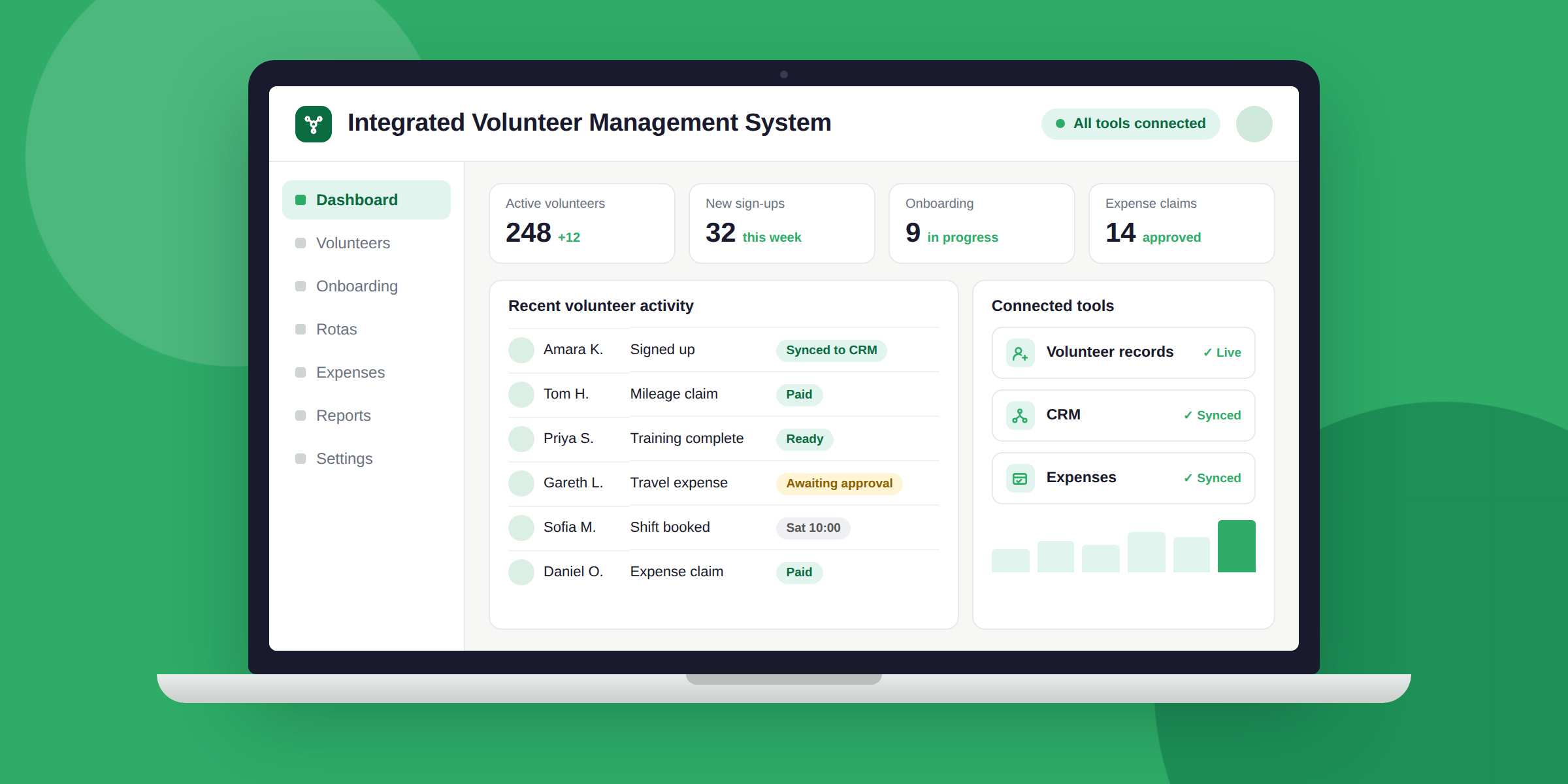
vHelp is a UK-based payment platform that pays volunteer expenses directly to the volunteer's bank account within 24 hours. Volunteers claim from their phone in under two minutes. Managers approve in one click. There are no spreadsheets, no email chains and no manual reconciliation, and every payment carries a full audit trail.
If you would like the full evidence behind this, our white paper Why Volunteers Quit: The Hidden Role of Expense Reimbursement in Retention sets out the research. You can also see how volunteer expense reimbursement works for charities, or email hello@vhelp.co.uk for a template expenses policy you can adapt.